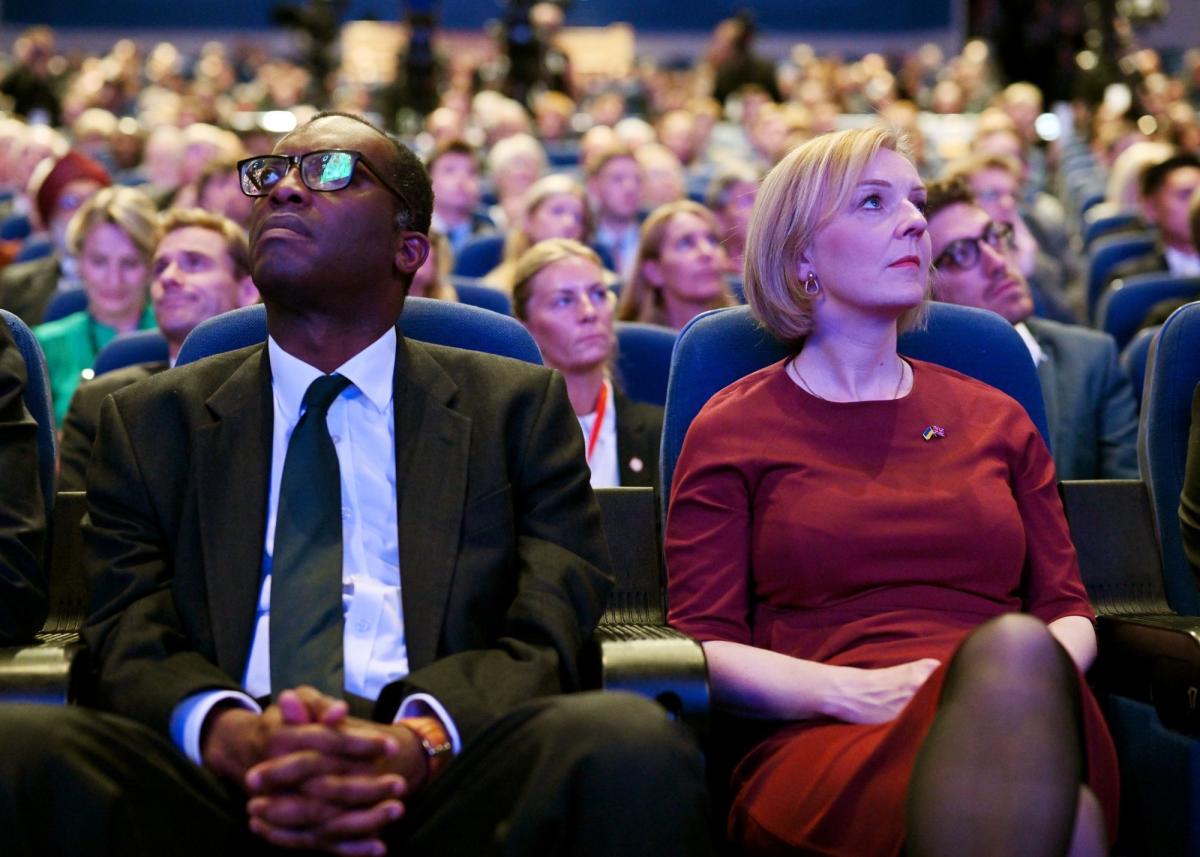
 Captain Blackadder was moved to say, “I think the phrase rhymes with clucking bell”. In the WW1 trenches of the Somme the unfortunate young infantry officer was grasping the reality of a suicidal military tactic, a weapons mis-match, no escape from an imminent charge ‘over the top’ order and no chance of the generals changing their minds. We get it. Kwasi Kwarteng says “we get it” too. But, only after ten long days, and any number of Treasury mandarins mouthing “clucking bell” at the comical tin ears of their political leaders and the brutality of financial markets’ declaration of no government credibility, or trust. Damage was terminal. So, don’t be fooled by the Kami-Kwasi reverse ferret on top tax rates, sterling’s recovery or the stabilisation of UK bond (gilt) markets.
Until the Bank of England intervened in financial markets on September 28th and effectively bailed out its own sovereign (innit) government we got a very good glimpse of the damage which stubborn leadership can do. I’ve been around for 1992 ERM debacles, 1998 LTCM hedge fund meltdowns, 2000 dot-com disasters and 2008 Lehman Brothers earthquakes where, with the exception of 1992, the story has often focused on how high-flyers have been brought down dramatically. The Lowenstein book on LTCM’s failure “When Genius Fails” is a must-read on how apparently sophisticated trading strategies can blow up but…. there’s possibly another book to be written.
As I read about the Chancellor’s champagne cocktails with hedge funds on mini-budget day and City insider references to “the useful idiot” I’m thinking of a tome documenting “When Idiots Reign”. The qualification for coverage in this narrative will be trillion dollar losses and the ignoring of sound advice. Furthermore, the corollary to all these stories will be massive profit windfalls for traders who employ the super-simple strategy of expecting the idiot leader to avoid all advice and plough ahead with the misguided action. The more I see, the more I believe this is the era of the “idiot trade”. Here are my top 3 so far but there will be more.
Trussonomics:
I actually have to pause when I write this, did it really happen? As flagged in our last article, Liz Truss and her Chancellor, Kwasi Kwarteng, fired their top Treasury official, Tom Scholar; ignored all financial market warnings from remaining Treasury officials; went ahead with a mini-budget of tax-cuts; provided no costings or evidence of funding of planned cuts; and finally promised “trickle down” growth would make everything alright in future years. Those that followed the “idiot trade” will have shared some staggering wins. Here was the scorecard by the time the Bank of England explicitly went against its own inflation fighting/tightening policy and actually made direct purchases of UK gilts/bonds in the markets:
Captain Blackadder was moved to say, “I think the phrase rhymes with clucking bell”. In the WW1 trenches of the Somme the unfortunate young infantry officer was grasping the reality of a suicidal military tactic, a weapons mis-match, no escape from an imminent charge ‘over the top’ order and no chance of the generals changing their minds. We get it. Kwasi Kwarteng says “we get it” too. But, only after ten long days, and any number of Treasury mandarins mouthing “clucking bell” at the comical tin ears of their political leaders and the brutality of financial markets’ declaration of no government credibility, or trust. Damage was terminal. So, don’t be fooled by the Kami-Kwasi reverse ferret on top tax rates, sterling’s recovery or the stabilisation of UK bond (gilt) markets.
Until the Bank of England intervened in financial markets on September 28th and effectively bailed out its own sovereign (innit) government we got a very good glimpse of the damage which stubborn leadership can do. I’ve been around for 1992 ERM debacles, 1998 LTCM hedge fund meltdowns, 2000 dot-com disasters and 2008 Lehman Brothers earthquakes where, with the exception of 1992, the story has often focused on how high-flyers have been brought down dramatically. The Lowenstein book on LTCM’s failure “When Genius Fails” is a must-read on how apparently sophisticated trading strategies can blow up but…. there’s possibly another book to be written.
As I read about the Chancellor’s champagne cocktails with hedge funds on mini-budget day and City insider references to “the useful idiot” I’m thinking of a tome documenting “When Idiots Reign”. The qualification for coverage in this narrative will be trillion dollar losses and the ignoring of sound advice. Furthermore, the corollary to all these stories will be massive profit windfalls for traders who employ the super-simple strategy of expecting the idiot leader to avoid all advice and plough ahead with the misguided action. The more I see, the more I believe this is the era of the “idiot trade”. Here are my top 3 so far but there will be more.
Trussonomics:
I actually have to pause when I write this, did it really happen? As flagged in our last article, Liz Truss and her Chancellor, Kwasi Kwarteng, fired their top Treasury official, Tom Scholar; ignored all financial market warnings from remaining Treasury officials; went ahead with a mini-budget of tax-cuts; provided no costings or evidence of funding of planned cuts; and finally promised “trickle down” growth would make everything alright in future years. Those that followed the “idiot trade” will have shared some staggering wins. Here was the scorecard by the time the Bank of England explicitly went against its own inflation fighting/tightening policy and actually made direct purchases of UK gilts/bonds in the markets:
- UK Equity and bond market losses combined were estimated at over $500 billion.
- The decline of the Great British Peso before and after a well-flagged mini-budget was a minimum 10% vs the US dollar which means the $3 trillion UK economy(GDP) in dollar terms has lost circa $300 billion of value.
- Total value of UK residential homes is just over £7 trillion. The mortgage loan market is just over £1.6 trillion. Pick your poison. As UK bonds/gilt interest rates rocketed mortgage holders were staring down the barrel of increased interest costs of $50 billion per year. Three years of that and you’re $150 billion poorer and that’s before house prices take some pain. There were some early post-budget meltdown estimates of house prices suffering 15% declines in a higher mortgage rate environment. I won’t name and shame that fantasy peddler. Be assured, the impact would be far worse but even a 15% hit would deliver a $1 trillion loss of value to the UK housing market alone.
- Russia’s overseas reserves amounting to over $400 billion have been frozen by central banks and monetary authorities. It is unlikely these monies will ever return to Moscow, more likely the funds will be used to rebuild Ukrainian cities and infrastructure.
- As the Russian army goes into “partial mobilisation” conscription mode it has run out of those sort of options on the military hardware side of things. The destruction of Russian military equipment amounts to years of manufacturing and defence spending. As a proxy for costing Russian military losses we have used 2021 data showing a $65 billion defence budget. At a minimum, the damage to the Russian army has been 5 years of spend or more than $300 billion.
- Russia’s GDP prior to war was equivalent to Spain’s $1.4 trillion. We have seen data showing the pull-out of more than 1,000 international firms and the knock-on effect for indigenous companies as being the equivalent of up to 40% of GDP. However, we will err on the side of caution and use World Bank forecasts of a 10% GDP drop in 2022, and assume the same in 2023. That gets us close to $300 billion of economic damage and pushes the overall cost of Putin’s folly at over a trillion dollars.
- Credit Suisse before Russia invaded Crimea in 2014 had total banking assets of a trillion dollars. Today, after multiple restructuring events, assets are still worth a whopping $750 billion.
- The CS Wealth division holds a further $1.6 trillion of client investment and custodial assets.
- Credit Suisse is one of only 30 banking institutions in the world described as “Global Systemically Important Banks” (G-SIB) by the Basel Committee on Banking Supervision. CS is important to everyone and, for context, Lehman Brothers’ assets at time of collapse in 2008 were “only” $600 billion.